Franciaország leghosszabb szárazföldi határa
Ha megkérdeznének, melyik országgal osztja Franciaország a leghosszabb szárazföldi határát, a legtöbben valószínűleg Spanyolországra vagy Németországra tippelnének. Pedig a helyes válasz sokkal meglepőbb.
Európa · Nyugat-Európa
Franciaország Nyugat-Európában fekszik, területe mintegy 551 000 négyzetkilométer, ezzel az Európai Unió legnagyobb tagállama. Az ország partvidékét egyszerre mossa az Atlanti-óceán, a La Manche csatorna és a Földközi-tenger, belső területein pedig az Alpok, a Pireneusok és a Massif Central hegyvidékei találhatók. Franciaország a világ leglátogatottabb országa nemzetközi turistaérkezések alapján, évente több tízmillió külföldi látogatót fogad. A hivatalos nyelv a francia, az ország 1958 óta ötödik köztársaságként működik, elnöki-parlamentáris rendszerben.
Párizs, a főváros, az Eiffel-toronnyal, amelyet 1889-ben építettek a világkiállításra, és a Louvre múzeummal, a világ egyik legnagyobb és leglátogatottabb művészeti gyűjteményével, az ország legismertebb úti célja. Versailles kastélya, XIV. Lajos egykori rezidenciája, tükörtermével és kiterjedt kertjeivel 1979 óta UNESCO világörökségi helyszín. Mont Saint-Michel, egy sziklás szigeten épült középkori apátság Normandia partjainál, amelyet dagálykor a tenger körülzár, szintén az UNESCO listáján szerepel. A Loire-völgy reneszánsz kastélyaival, köztük Chambord és Chenonceau kastélyokkal, Franciaország egyik leggazdagabb történelmi tájegysége.
Franciaország borvidékei, köztük Bordeaux, Burgundia és Champagne, a világ legismertebb borászati régiói közé tartoznak, ahol a szőlőtermesztés hagyománya évszázados múltra tekint vissza. A francia Alpok, olyan üdülőhelyekkel, mint Chamonix, amely a Mont Blanc lábánál fekszik, kiváló terepet biztosítanak a téli sportokhoz és a hegyi túrázáshoz egyaránt. A Provence levendulamezői, amelyek júniustól augusztusig virágoznak, az ország délkeleti részének jellegzetes nyári látványossága. A Côte d'Azur, Franciaország délkeleti tengerpartja Nizza és Cannes városai között, a 19. század óta az európai luxusturizmus egyik központja, ahol a sziklás partszakaszok és a kis öblök mellett a Cannes-i Filmfesztivál is évente nemzetközi figyelmet vonz a régióra. A helyi konyha régiónként rendkívül változatos, jellegzetes fogása a coq au vin (borban párolt csirke) és a baguette, míg a sajt- és borkultúra a francia gasztronómia szerves részét képezi.
Franciaországhoz Európán kívül tizenkét tengerentúli terület tartozik, amelyek jogi státusza jelentősen eltér egymástól: vannak köztük tengerentúli megyék, amelyek közigazgatásilag teljes mértékben Franciaország részét képezik, és vannak úgynevezett tengerentúli kollektivitások, amelyek nagyobb önállósággal rendelkeznek. Ez a rendkívül sokszínű terület a Karib-térségtől (Guadeloupe, Martinique, Saint-Martin, Saint-Barthélemy) az Indiai-óceánon (Réunion, Mayotte) és Dél-Amerikán (Francia Guyana) át egészen a Csendes-óceánig (Francia Polinézia, Új-Kaledónia, Wallis és Futuna) és az Atlanti-óceán északi részéig (Saint-Pierre és Miquelon) húzódik. Külön kategóriát képviselnek a Francia Déli és Antarktiszi Területek, amelyeknek nincs állandó lakossága, csak tudományos kutatóállomásaik.
Öt francia tengerentúli terület, Guadeloupe, Martinique, Francia Guyana, Réunion és Mayotte, tengerentúli megyeként (département d'outre-mer) közigazgatásilag ugyanolyan jogállással rendelkezik, mint egy franciaországi megye, ezáltal teljes jogú részei az Európai Uniónak is, az uniós jog és az euró valuta ezeken a területeken is érvényes. Ezt a jogállást az Európai Unió "legkülső régiónak" (région ultrapériphérique) nevezi, ami bizonyos gazdasági és mezőgazdasági támogatási programok esetén eltérő szabályozást is lehetővé tesz a kontinentális Franciaországhoz képest. A lakosok teljes jogú francia és uniós állampolgárok, szavazati joggal rendelkeznek a francia és az európai parlamenti választásokon egyaránt.
A többi francia tengerentúli terület, köztük Francia Polinézia, Új-Kaledónia, Saint-Martin, Saint-Barthélemy, Saint-Pierre és Miquelon, valamint Wallis és Futuna, úgynevezett tengerentúli kollektivitásként (collectivité d'outre-mer) vagy különleges jogállású területként kapcsolódik Franciaországhoz, nagyobb helyi önállósággal, de nem tartozik az Európai Unióhoz, csupán "tengerentúli ország vagy terület" (OCT) besorolást élvez, amely korlátozottabb uniós jogalkalmazást jelent. Új-Kaledónia egyedi jogállással rendelkezik a francia alkotmányon belül, saját törvényhozással és jelentős helyi hatáskörökkel, beleértve a múltban tartott, függetlenségről szóló népszavazásokat is. A Francia Déli és Antarktiszi Területek, mivel nincs állandó lakosságuk, sem az EU-hoz, sem a fenti kategóriák egyikéhez nem sorolhatók egyértelműen, közigazgatásilag önálló tengerentúli területként működnek saját adminisztrátorral.
Perched on a rocky islet in the midst of vast sandbanks exposed to powerful tides between Normandy and Brittany stand the 'Wonder of the West', a Gothic-style Benedictine abbey dedicated to the archangel St Michael, and the village that grew up in the shadow of its great walls. Built between the 11th and 16th centuries, the abbey is a technical and artistic tour de force, having had to adapt to the problems posed by this unique natural site.
Partly built starting in 1145, and then reconstructed over a 26-year period after the fire of 1194, Chartres Cathedral marks the high point of French Gothic art. The vast nave, in pure ogival style, the porches adorned with fine sculptures from the middle of the 12th century, and the magnificent 12th- and 13th-century stained-glass windows, all in remarkable condition, combine to make it a masterpiece.
The Vézère valley contains 147 prehistoric sites dating from the Palaeolithic and 25 decorated caves. It is particularly interesting from an ethnological and anthropological, as well as an aesthetic point of view because of its cave paintings, especially those of the Lascaux Cave, whose discovery in 1940 was of great importance for the history of prehistoric art. The hunting scenes show some 100 animal figures, which are remarkable for their detail, rich colours and lifelike quality.
Shortly after its foundation in the 9th century, the Benedictine abbey of Vézelay acquired the relics of St Mary Magdalene and since then it has been an important place of pilgrimage. St Bernard preached the Second Crusade there in 1146 and Richard the Lion-Hearted and Philip II Augustus met there to leave for the Third Crusade in 1190. With its sculpted capitals and portal, the Madeleine of Vézelay – a 12th-century monastic church – is a masterpiece of Burgundian Romanesque art and architecture.
The Palace of Versailles was the principal residence of the French kings from the time of Louis XIV to Louis XVI. Embellished by several generations of architects, sculptors, decorators and landscape architects, it provided Europe with a model of the ideal royal residence for over a century.
Used by the kings of France from the 12th century, the medieval royal hunting lodge of Fontainebleau, standing at the heart of a vast forest in the Ile-de-France, was transformed, enlarged and embellished in the 16th century by François I, who wanted to make a 'New Rome' of it. Surrounded by an immense park, the Italianate palace combines Renaissance and French artistic traditions.
Arles is a good example of the adaptation of an ancient city to medieval European civilization. It has some impressive Roman monuments, of which the earliest – the arena, the Roman theatre and the cryptoporticus (subterranean galleries) – date back to the 1st century B.C. During the 4th century Arles experienced a second golden age, as attested by the baths of Constantine and the necropolis of Alyscamps. In the 11th and 12th centuries, Arles once again became one of the most attractive cities in the Mediterranean. Within the city walls, Saint-Trophime, with its cloister, is one of Provence's major Romanesque monuments.
Amiens Cathedral, in the heart of Picardy, is one of the largest 'classic' Gothic churches of the 13th century. It is notable for the coherence of its plan, the beauty of its three-tier interior elevation and the particularly fine display of sculptures on the principal facade and in the south transept.
This stark Burgundian monastery was founded by St Bernard in 1119. With its church, cloister, refectory, sleeping quarters, bakery and ironworks, it is an excellent illustration of the ideal of self-sufficiency as practised by the earliest communities of Cistercian monks.
Situated in the Rhone valley, the ancient theatre of Orange, with its 103-m-long facade, is one of the best preserved of all the great Roman theatres. Built between A.D. 10 and 25, the Roman arch is one of the most beautiful and interesting surviving examples of a provincial triumphal arch from the reign of Augustus. It is decorated with low reliefs commemorating the establishment of the Pax Romana.
The Royal Saltworks of Arc-et-Senans, near Besançon, was built by Claude Nicolas Ledoux. Its construction, begun in 1775 during the reign of Louis XVI, was the first major achievement of industrial architecture, reflecting the ideal of progress of the Enlightenment. The vast, semicircular complex was designed to permit a rational and hierarchical organization of work and was to have been followed by the building of an ideal city, a project that was never realized. The Great Saltworks of Salins-les-Bains was active for at least 1200 years until stopping activity in 1962. From 1780 to 1895, its salt water travelled through 21 km of wood pipes to the Royal Saltworks of Arc-et-Senans. It was built near the immense Chaux Forest to ensure its supply of wood for fuel. The Saltworks of Salins shelters an underground gallery from the 13th century including a hydraulic pump from the 19th century that still functions. The boiler house demonstrates the difficulty of the saltworkers’ labour to collect the “White Gold”.
The nature reserve, which is part of the Regional Natural Park of Corsica, occupies the Scandola peninsula, an impressive, porphyritic rock mass. The vegetation is an outstanding example of scrubland. Seagulls, cormorants and sea eagles can be found there. The clear waters, with their islets and inaccessible caves, host a rich marine life.
Nancy, the temporary residence of a king without a kingdom – Stanislas Leszczynski, later to become Duke of Lorraine – is paradoxically the oldest and most typical example of a modern capital where an enlightened monarch proved to be sensitive to the needs of the public. Built between 1752 and 1756 by a brilliant team led by the architect Héré, this was a carefully conceived project that succeeded in creating a capital that not only enhanced the sovereign's prestige but was also functional.
Known as the 'Romanesque Sistine Chapel', the Abbey-Church of Saint-Savin contains many beautiful 11th- and 12th-century murals which are still in a remarkable state of preservation.
The Pont du Gard was built shortly before the Christian era to allow the aqueduct of Nîmes (which is almost 50 km long) to cross the Gard river. The Roman architects and hydraulic engineers who designed this bridge, which stands almost 50 m high and is on three levels – the longest measuring 275 m – created a technical as well as an artistic masterpiece.
The initial property, inscribed in 1988 on the World Heritage List, was formed by the Grande-Île, the historic centre of Strasbourg, structured around the cathedral. The extension concerns the Neustadt, new town, designed and built under the German administration (1871-1918). The Neustadt draws the inspiration for its urban layout partially from the Haussmannian model, while adopting an architectural idiom of Germanic inspiration. This dual influence has enabled the creation of an urban space that is specific to Strasbourg, where the perspectives created around the cathedral open to a unified landscape around the rivers and canals.
The outstanding handling of new architectural techniques in the 13th century, and the harmonious marriage of sculptural decoration with architecture, has made Notre-Dame in Reims one of the masterpieces of Gothic art. The former abbey still has its beautiful 9th-century nave, in which lie the remains of Archbishop St Rémi (440–533), who instituted the Holy Anointing of the kings of France. The former archiepiscopal palace known as the Tau Palace, which played an important role in religious ceremonies, was almost entirely rebuilt in the 17th century.
From the Louvre to the Eiffel Tower, from the Place de la Concorde to the Grand and Petit Palais, the evolution of Paris and its history can be seen from the River Seine. The Cathedral of Notre-Dame and the Sainte Chapelle are architectural masterpieces while Haussmann's wide squares and boulevards influenced late 19th- and 20th-century town planning the world over.
The Cathedral of St Etienne of Bourges, built between the late 12th and late 13th centuries, is one of the great masterpieces of Gothic art and is admired for its proportions and the unity of its design. The tympanum, sculptures and stained-glass windows are particularly striking. Apart from the beauty of the architecture, it attests to the power of Christianity in medieval France.
In the 14th century, this city in the South of France was the seat of the papacy. The Palais des Papes, an austere-looking fortress lavishly decorated by Simone Martini and Matteo Giovanetti, dominates the city, the surrounding ramparts and the remains of a 12th-century bridge over the Rhone. Beneath this outstanding example of Gothic architecture, the Petit Palais and the Romanesque Cathedral of Notre-Dame-des-Doms complete an exceptional group of monuments that testify to the leading role played by Avignon in 14th-century Christian Europe.
This 360-km network of navigable waterways linking the Mediterranean and the Atlantic through 328 structures (locks, aqueducts, bridges, tunnels, etc.) is one of the most remarkable feats of civil engineering in modern times. Built between 1667 and 1694, it paved the way for the Industrial Revolution. The care that its creator, Pierre-Paul Riquet, took in the design and the way it blends with its surroundings turned a technical achievement into a work of art.
Since the pre-Roman period, a fortified settlement has existed on the hill where Carcassonne now stands. In its present form it is an outstanding example of a medieval fortified town, with its massive defences encircling the castle and the surrounding buildings, its streets and its fine Gothic cathedral. Carcassonne is also of exceptional importance because of the lengthy restoration campaign undertaken by Viollet-le-Duc, one of the founders of the modern science of conservation.
This outstanding mountain landscape, which spans the contemporary national borders of France and Spain, is centred around the peak of Mount Perdu, a calcareous massif that rises to 3,352 m. The site, with a total area of 30,639 ha, includes two of Europe's largest and deepest canyons on the Spanish side and three major cirque walls on the more abrupt northern slopes with France, classic presentations of these geological landforms. The site is also a pastoral landscape reflecting an agricultural way of life that was once widespread in the upland regions of Europe but now survives only in this part of the Pyrénées. Thus it provides exceptional insights into past European society through its landscape of villages, farms, fields, upland pastures and mountain roads.
The long history of Lyon, which was founded by the Romans in the 1st century B.C. as the capital of the Three Gauls and has continued to play a major role in Europe's political, cultural and economic development ever since, is vividly illustrated by its urban fabric and the many fine historic buildings from all periods.
Santiago de Compostela was the supreme goal for countless thousands of pious pilgrims who converged there from all over Europe throughout the Middle Ages. To reach Spain pilgrims had to pass through France, and the group of important historical monuments included in this inscription marks out the four routes by which they did so.
Twenty-three belfries in the north of France and the belfry of Gembloux in Belgium were inscribed in 2005, as an extension to the 32 Belgian belfries inscribed in 1999 as Belfries of Flanders and Wallonia. Built between the 11th and 17th centuries, they showcase the Roman, Gothic, Renaissance and Baroque styles of architecture. They are highly significant tokens of the winning of civil liberties. While Italian, German and English towns mainly opted to build town halls, in part of north-western Europe, greater emphasis was placed on building belfries. Compared with the keep (symbol of the seigneurs) and the bell-tower (symbol of the Church), the belfry, the third tower in the urban landscape, symbolizes the power of the aldermen. Over the centuries, they came to represent the influence and wealth of the towns.
Viticulture was introduced to this fertile region of Aquitaine by the Romans, and intensified in the Middle Ages. The Saint-Emilion area benefited from its location on the pilgrimage route to Santiago de Compostela and many churches, monasteries and hospices were built there from the 11th century onwards. It was granted the special status of a 'jurisdiction' during the period of English rule in the 12th century. It is an exceptional landscape devoted entirely to wine-growing, with many fine historic monuments in its towns and villages.
The Loire Valley is an outstanding cultural landscape of great beauty, containing historic towns and villages, great architectural monuments (the châteaux), and cultivated lands formed by many centuries of interaction between their population and the physical environment, primarily the river Loire itself.
The fortified medieval town of Provins is situated in the former territory of the powerful Counts of Champagne. It bears witness to early developments in the organization of international trading fairs and the wool industry. The urban structure of Provins, which was built specifically to host the fairs and related activities, has been well preserved.
The city of Le Havre, on the English Channel in Normandy, was severely bombed during the Second World War. The destroyed area was rebuilt according to the plan of a team headed by Auguste Perret, from 1945 to 1964. The site forms the administrative, commercial and cultural centre of Le Havre. Le Havre is exceptional among many reconstructed cities for its unity and integrity. It combines a reflection of the earlier pattern of the town and its extant historic structures with the new ideas of town planning and construction technology. It is an outstanding post-war example of urban planning and architecture based on the unity of methodology and the use of prefabrication, the systematic utilization of a modular grid, and the innovative exploitation of the potential of concrete.
This transnational property includes 93 component parts in 18 countries. Since the end of the last Ice Age, European Beech spread from a few isolated refuge areas in the Alps, Carpathians, Dinarides, Mediterranean and Pyrenees over a short period of a few thousand years in a process that is still ongoing. The successful expansion across a whole continent is related to the tree’s adaptability and tolerance of different climatic, geographical and physical conditions.
The Port of the Moon, port city of Bordeaux in south-west France, is inscribed as an inhabited historic city, an outstanding urban and architectural ensemble, created in the age of the Enlightenment, whose values continued up to the first half of the 20th century, with more protected buildings than any other French city except Paris. It is also recognized for its historic role as a place of exchange of cultural values over more than 2,000 years, particularly since the 12th century due to commercial links with Britain and the Low Lands. Urban plans and architectural ensembles of the early 18th century onwards place the city as an outstanding example of innovative classical and neoclassical trends and give it an exceptional urban and architectural unity and coherence. Its urban form represents the success of philosophers who wanted to make towns into melting pots of humanism, universality and culture.
Fortifications of Vauban consists of 12 groups of fortified buildings and sites along the western, northern and eastern borders of France. They represent the finest examples of the work of Sébastien Le Prestre de Vauban (1633-1707), a military engineer of King Louis XIV. The serial property includes towns built from scratch by Vauban, citadels, urban bastion walls and bastion towers. There are also mountain forts, sea forts, a mountain battery and two mountain communication structures. This property is inscribed as bearing witness to the peak of classic fortifications, typical of western military architecture. Vauban also played a major role in the history of fortification in Europe and on other continents until the mid-19th century.
This serial site comprises six marine clusters that represent the main diversity of coral reefs and associated ecosystems in the French Pacific Ocean archipelago of New Caledonia and one of the three most extensive reef systems in the world. These Lagoons are of exceptional natural beauty. They feature an exceptional diversity of coral and fish species and a continuum of habitats from mangroves to seagrasses with the world’s most diverse concentration of reef structures. The Lagoons of New Caledonia display intact ecosystems, with healthy populations of large predators, and a great number and diversity of big fish. They provide habitat to a number of emblematic or threatened marine species such as turtles, whales or dugongs whose population here is the third largest in the world.
The Pitons, cirques and remparts of Reunion Island site coincides with the core zone of La Réunion National Park. The property covers more than 100,000 ha or 40 % of La Réunion, an island comprising two adjoining volcanic massifs located in the south-west of the Indian Ocean. Dominated by two towering volcanic peaks, massive walls and three cliff-rimmed cirques, the property includes a great variety of rugged terrain and impressive escarpments, forested gorges and basins creating a visually striking landscape. It is the natural habitat for a wide diversity of plants, presenting a high level of endemism. There are subtropical rainforests, cloud forests and heaths creating a remarkable and visually appealing mosaic of ecosystems and landscape features.
On the banks of the Tarn river in south-west France, the old city of Albi reflects the culmination of a medieval architectural and urban ensemble. Today the Old Bridge (Pont-Vieux), the Saint-Salvi quarter and its church are testimony to its initial development (10th -11th centuries). Following the Albigensian Crusade against the Cathar heretics (13th century) it became a powerful episcopal city. Built in a unique southern French Gothic style from local brick in characteristic red and orange colours, the lofty fortified Cathedral (late 13th century) dominates the city, demonstrating the power regained by the Roman Catholic clergy. Alongside the Cathedral is the vast bishop’s Palais de la Berbie, overlooking the river and surrounded by residential quarters that date back to the Middle Ages. The Episcopal City of Albi forms a coherent and homogeneous ensemble of monuments and quarters that has remained largely unchanged over the centuries.
This 302,319 ha property, in the southern part of central France, is a mountain landscape interspersed by deep valleys that is representative of the relationship between agro-pastoral systems and their biophysical environment, notably through drailles or drove roads. Villages and substantial stone farmhouses on deep terraces of the Causses reflect the organization of large abbeys from the 11th century. Mont Lozère, inside the property, is one of the last places where summer transhumance is still practiced in the traditional way, using the drailles.
This serial property of 111 small individual sites encompasses the remains of prehistoric pile-dwelling (or stilt house) settlements in and around the Alps built from around 5000 to 500 B.C. on the edges of lakes, rivers or wetlands. Excavations, only conducted in some of the sites, have yielded evidence that provides insight into life in prehistoric times during the Neolithic and Bronze Age in Alpine Europe and the way communities interacted with their environment. Fifty-six of the sites are located in Switzerland. The settlements are a unique group of exceptionally well-preserved and culturally rich archaeological sites, which constitute one of the most important sources for the study of early agrarian societies in the region.
Remarkable as a landscape shaped over three centuries of coal extraction from the 1700s to the 1900s, the site consists of 109 separate components over 120,000 ha. It features mining pits (the oldest of which dates from 1850) and lift infrastructure, slag heaps (some of which cover 90 ha and exceed 140 m in height), coal transport infrastructure, railway stations, workers’ estates and mining villages including social habitat, schools, religious buildings, health and community facilities, company premises, owners and managers’ houses, town halls and more. The site bears testimony to the quest to create model workers’ cities from the mid 19th century to the 1960s and further illustrates a significant period in the history of industrial Europe. It documents the living conditions of workers and the solidarity to which it gave rise.
Located in a limestone plateau of the Ardèche River in southern France, the property contains the earliest-known and best-preserved figurative drawings in the world, dating back as early as the Aurignacian period (30,000–32,000 BP), making it an exceptional testimony of prehistoric art. The cave was closed off by a rock fall approximately 20,000 years BP and remained sealed until its discovery in 1994, which helped to keep it in pristine condition. Over 1,000 images have so far been inventoried on its walls, combining a variety of anthropomorphic and animal motifs. Of exceptional aesthetic quality, they demonstrate a range of techniques including the skilful use of shading, combinations of paint and engraving, anatomical precision, three-dimensionality and movement. They include several dangerous animal species difficult to observe at that time, such as mammoth, bear, cave lion, rhino, bison and auroch, as well as 4,000 inventoried remains of prehistoric fauna and a variety of human footprints.
The climates are precisely delimited vineyard parcels on the slopes of the Côte de Nuits and the Côte de Beaune south of the city of Dijon. They differ from one another due to specific natural conditions (geology and exposure) as well as vine types and have been shaped by human cultivation. Over time they came to be recognized by the wine they produce. This cultural landscape consists of two parts. Firstly, the vineyards and associated production units including villages and the town of Beaune, which together represent the commercial dimension of the production system. The second part includes the historic centre of Dijon, which embodies the political regulatory impetus that gave birth to the climats system. The site is an outstanding example of grape cultivation and wine production developed since the High Middle Ages.
The property encompasses sites where the method of producing sparkling wines was developed on the principle of secondary fermentation in the bottle since the early 17th century to its early industrialization in the 19th century. The property is made up of three distinct ensembles: the historic vineyards of Hautvillers, Aÿ and Mareuil-sur-Aÿ, Saint-Nicaise Hill in Reims, and the Avenue de Champagne and Fort Chabrol in Epernay. These three components – the supply basin formed by the historic hillsides, the production sites (with their underground cellars) and the sales and distribution centres (the Champagne Houses) - illustrate the entire champagne production process. The property bears clear testimony to the development of a very specialized artisan activity that has become an agro-industrial enterprise.
Chosen from the work of Le Corbusier, the 17 sites comprising this transnational serial property are spread over seven countries and are a testimonial to the invention of a new architectural language that made a break with the past. They were built over a period of a half-century, in the course of what Le Corbusier described as “patient research”. The Complexe du Capitole in Chandigarh (India), the National Museum of Western Art, Tokyo (Japan), the House of Dr Curutchet in La Plata (Argentina) and the Unité d’habitation in Marseille (France) reflect the solutions that the Modern Movement sought to apply during the 20th century to the challenges of inventing new architectural techniques to respond to the needs of society. These masterpieces of creative genius also attest to the internationalization of architectural practice across the planet.
Taputapuātea on Ra’iātea Island is at the centre of the ‘Polynesian Triangle’, a vast portion of the Pacific Ocean, dotted with islands, and the last part of the globe to be settled by humans. The property includes two forested valleys, a portion of lagoon and coral reef and a strip of open ocean. At the heart of the property is the Taputapuātea marae complex, a political, ceremonial and funerary centre. It is characterized by several marae, with different functions. Widespread in Polynesia, the marae were places where the world of the living intersected the world of the ancestors and the gods. Taputapuātea is an exceptional testimony to 1,000 years of mā'ohi civilization.
Situated in the centre of France, the property comprises the long Limagne fault, the alignments of the Chaîne des Puys volcanoes and the inverted relief of the Montagne de la Serre. It is an emblematic segment of the West European Rift, created in the aftermath of the formation of the Alps, 35 million years ago. The geological features of the property demonstrate how the continental crust cracks, then collapses, allowing deep magma to rise and cause uplifting at the surface. The property is an exceptional illustration of continental break-up – or rifting – which is one of the five major stages of plate tectonics.
The French Austral Lands and Seas comprise the largest of the rare emerged landmasses in the southern Indian Ocean: the Crozet Archipelago, the Kerguelen Islands, Saint-Paul and Amsterdam Islands as well as 60 small sub-Antarctic islands. This ‘oasis’ in the middle of the Southern Ocean covers an area of more than 166 million ha and supports one of the highest concentrations of birds and marine mammals in the world. In particular, it has the largest population of King Penguins and Yellow-nosed albatrosses in the world. The remoteness of these islands from centres of human activity makes them extremely well-preserved showcases of biological evolution and a unique terrain for scientific research.
The Lighthouse of Cordouan rises up on a shallow rocky plateau in the Atlantic Ocean at the mouth of the Gironde estuary in the Nouvelle-Aquitaine region, in a highly exposed and hostile environment. Built in white limestone dressed blocks at the turn of the 16th and 17th centuries, it was designed by engineer Louis de Foix and remodelled by engineer Joseph Teulère in the late 18th century. A masterpiece of maritime signalling, Cordouan’s monumental tower is decorated with pilasters, columns modillions and gargoyles. It embodies the great stages of the architectural and technological history of lighthouses and was built with the ambition of continuing the tradition of famous beacons of antiquity, illustrating the art of building lighthouses in a period of renewed navigation, when beacons played an important role as territorial markers and as instruments of safety. Finally, the increase of its height, in the late 18th century, and the changes to its light chamber, attest to the progress of science and technology of the period. Its architectural forms drew inspiration from ancient models, Renaissance Mannerism and the specific architectural language of France’s engineering school École des Ponts et Chaussées.
Nice, located on the Mediterranean, at the foot of the Alps, near the Italian border, in the Provence-Alpes-Côte d’Azur region, reflects the development of a city devoted to winter tourism, making the most of its mild climate and its coastal situation, between sea and mountains. From the mid-18th century, the site attracted growing numbers of aristocratic and upper-class families, mainly British, who developed the habit of spending their winters there. In 1832, Nice, then part of the Kingdom of Sardinia, set up the “Consiglio d’Ornato” which drew up a city planning scheme and architectural requirements designed to make the city attractive to foreigners. Thus, the “Camin dei Ingles”, a modest path which had been created along the coastline by British winter visitors in 1824, subsequently became the prestigious Promenade des Anglais. After the city was ceded to France in 1860, and thanks to its connection to the European rail network, an increasing number of winter visitors from all countries flocked to the city. This led to successive phases of development of new districts beyond the medieval old town. The diverse cultural influences of the winter visitors and the desire to make the most of the weather conditions and the coastal landscape have shaped the urban development and eclectic architectural styles of these districts, contributing to Nice’s reputation as a cosmopolitan winter resort.
This transnational serial property comprises eleven spa towns, located in seven European countries: Baden bei Wien (Austria); Spa (Belgium); Františkovy Lázně; Karlovy Vary; Mariánské Lázně (Czechia); Vichy (France); Bad Ems; Baden-Baden; Bad Kissingen (Germany); Montecatini Terme (Italy); and City of Bath (United Kingdom). All of these towns developed around natural mineral water springs. They bear witness to the international European spa culture that developed from the early 18th century to the 1930s, leading to the emergence of grand international resorts that impacted urban typology around ensembles of spa buildings such as baths, kurhaus and kursaal (buildings and rooms dedicated to therapy), pump rooms, drinking halls, colonnades and galleries designed to harness the natural mineral water resources and to allow their practical use for bathing and drinking. Related facilities include gardens, assembly rooms, casinos, theatres, hotels and villas, as well as spa-specific support infrastructure. These ensembles are all integrated into an overall urban context that includes a carefully managed recreational and therapeutic environment in a picturesque landscape. Together, these sites embody the significant interchange of human values and developments in medicine, science and balneology.
All along the Western Front of the First World War, which stretched for some 700 km from the North Sea to the Franco-Swiss border, a series of 139 funerary and memorial sites bear witness to the common desire of the various parties involved in the conflict to honour their children who fell in battle. This objective takes the form of individual graves and/or memorials listing the names of the missing. Places dedicated to meditation, remembrance and tributes are specially created. Beyond the diversity in size, location and design, there is a clear desire to create spaces that are worthy of the sacrifice made. This is reflected in the choice of noble materials, as well as in calls for renowned architects, botanists, landscape architects and artists to design sites of exceptional architectural, artistic and landscape quality. These sites are visited daily by pilgrims, individual visitors, official delegations, school groups, local community representatives and descendants. They bear witness to funerary and memorial practices that are still relevant today, as remains discovered by chance or during archaeological excavations are still buried there with all honours. These commemorative sites represent a heritage that almost literally belongs to the whole world, spreading a message of reconciliation that is still very topical.
The global significance of Mount Pelée and Pitons du Carbet is based on its representation of volcanic processes and forest types. The 1902 eruption is considered the deadliest volcanic event of the 20th century, and a worldwide reference for the history of volcanology. All the forest types and the diversity of endemic plants of the Lesser Antilles are represented in the serial property, within forest continuums ranging from the seashore to the volcanic summits. The property is home to globally threatened species such as the Martinique Volcano Frog (Allobates chalcopis) and the Martinique Oriole (Icterus bonana), two strict endemics.
Built in the 1st century AD in the Roman colony of Nemausus – today’s city of Nîmes in the Occitanie region– the Maison Carrée is one of the earliest examples of a Roman temple which can be connected to the imperial worship in the provinces of Rome. Dedicated to the presumptive heirs of Augustus, the princes of Youth, prematurely deceased, this building confirmed the control of Rome on the conquered territory while expressing in a symbolic way the allegiance and attachment of the people from the city of Nemausus to Augustus’ dynasty. The architecture of the Maison Carrée and its sophisticated decoration took part, symbolically, in the dissemination of Augustus ideologic program which turned the Ancient Rome from republic to empire, thus opening a new golden age bearer of promises of peace, prosperity and stability known by the name of Pax Romana.
Located in the South Pacific Ocean, this mixed serial property bears an exceptional testimony to the territorial occupation of the Marquesas archipelago by a human civilisation that arrived by sea around the year 1000 CE and developed on these isolated islands between the 10th and the 19th centuries. It is also a hotspot of biodiversity that combines irreplaceable and exceptionally well conserved marine and terrestrial ecosystems. Marked by sharp ridges, impressive peaks and cliffs rising abruptly above the ocean, the landscapes of the archipelago are unparalleled in these tropical latitudes. The archipelago is a major centre of endemism, home to rare and diverse flora, a diversity of emblematic marine species, and one of the most diverse seabird assemblages in the South Pacific. Virtually free from human exploitation, Marquesan waters are among the world’s last marine wilderness areas. The property also includes archaeological sites ranging from monumental dry-stone structures to lithic sculptures and engravings.
This serial property in Brittany, France, features a dense concentration of megalithic structures built during the Neolithic period (c. 5000–2300 BCE), carefully aligned with the area’s unique geomorphology. These monumental stone constructions—arranged in relation to one another and to natural features like terrain and waterways—reflect a sophisticated understanding of the environment. Rich engravings and associated artifacts further illustrate the cultural complexity of the societies that inhabited this part of the European Atlantic coast.
Adatok: UNESCO WHC · CC BY-SA 4.0
Ha megkérdeznének, melyik országgal osztja Franciaország a leghosszabb szárazföldi határát, a legtöbben valószínűleg Spanyolországra vagy Németországra tippelnének. Pedig a helyes válasz sokkal meglepőbb.
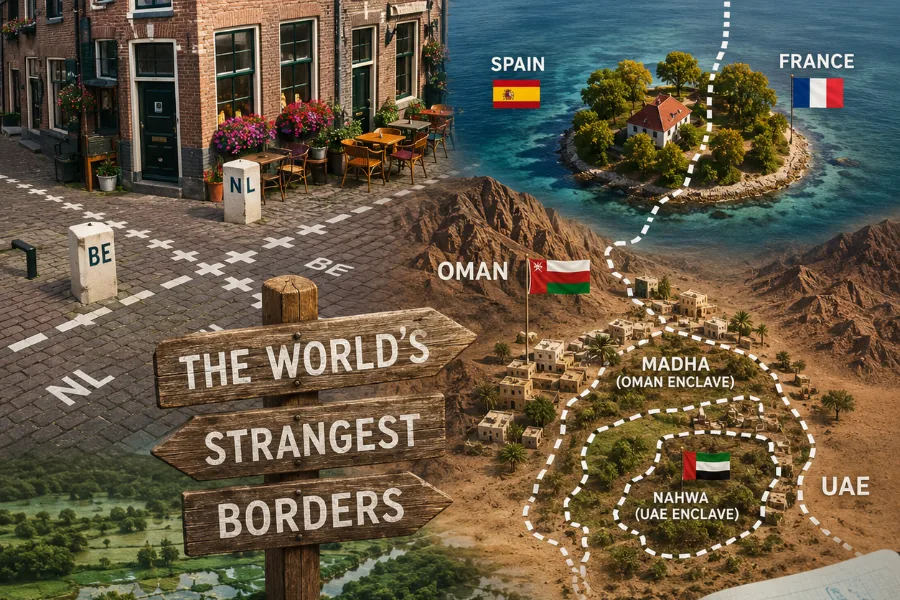
A legtöbb országhatár viszonylag egyszerű vonal a térképen. Vannak azonban olyan helyek a világon, ahol a történelem, a házasságok, a földcserék vagy éppen a gyarmati megállapodások egészen elképesztő határokat rajzoltak. Íme néhány olyan hely, amelyet minden földrajzrajongónak látnia kell legalább egyszer.
Franciaország fővárosa Párizs.
Franciaország területe 551 695 km².
Franciaország lakossága 68 551 653 fő.
Franciaország pénzneme: Euró (EUR).
Franciaország hivatalos nyelve: francia.
Franciaország közlekedési oldala: Jobb oldali közlekedés.
Igen, Franciaország az Európai Unió tagja.
Igen, Franciaország az Egyesült Nemzetek Szervezetének (ENSZ) tagja.