8 UNESCO World Heritage Sites of Hungary
Hungary joined the UNESCO World Heritage Convention in 1985, and since then a total of 8 sites have made it onto the list – seven cultural and one natural. In this article we go through each one: when they were inscribed, and what makes them unique.
Budapest – Banks of the Danube, Buda Castle Quarter and Andrássy Avenue
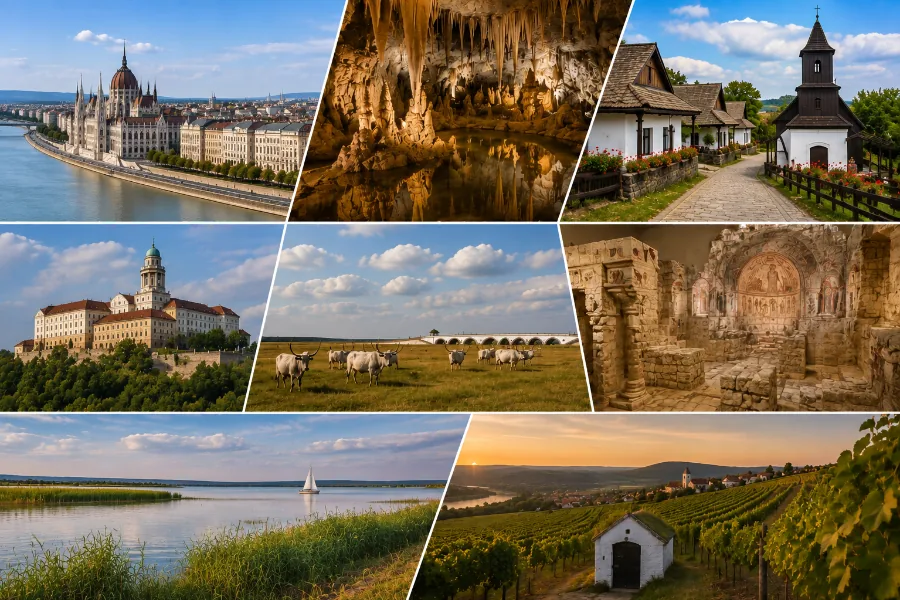
Hungary's first World Heritage site was inscribed in 1987: the banks of the Danube and the Buda Castle Quarter, including Buda Castle, Fisherman's Bastion and Gellért Hill. The site was extended in 2002 to include Andrássy Avenue and its historical surroundings, which take in the Opera House, the Academy of Music, the Museum of Fine Arts and Heroes' Square.
Old Village of Hollókő
Also inscribed in 1987, alongside Budapest, is the old village of Hollókő. Located in a valley of the Cserhát hills and home to around 400 people, the village preserves the traditional architecture of the Palóc ethnic group – its historic core consists of about 55 houses, most of which are still lived in today.
Caves of Aggtelek Karst and Slovak Karst
Hungary's only natural World Heritage site was inscribed in 1995, and it's a shared site with Slovakia, since the cave system crosses the border. It includes more than 700 caves altogether, with varied stalactite formations and rare cave-dwelling wildlife.
Millenary Benedictine Abbey of Pannonhalma
The Benedictine monastery founded by Prince Géza has been a World Heritage site since 1996. The abbey is still active today, home to monks who are involved in education, winemaking and maintaining a herb garden – making it both a religious and art-historical site and a living community.
Hortobágy National Park
Hortobágy was inscribed in 1999 as Europe's largest continuous natural grassland puszta. What makes the site unique isn't just the landscape, but that it represents a thousand-year example of harmonious coexistence between people and nature – the site also includes the iconic sweep-pole wells and the Nine-Arch Bridge.
Early Christian Necropolis of Pécs (Sopianae)
The Early Christian necropolis of Pécs was inscribed in 2000, and it's the only Hungarian site listed specifically under the cultural-historical category. The 4th-century burial chambers, mausoleums and cemetery buildings form one of the largest continuous early Christian burial complexes outside ancient Italy.
Fertő / Neusiedlersee Cultural Landscape
Lake Fertő and its surroundings gained World Heritage status in 2001, as a shared site with Austria. The lake is one of Europe's internationally important wetlands and the continent's largest saltwater lake, its shores marked by a cultural landscape closely intertwined with its natural environment for centuries.
Tokaj Wine Region Historic Cultural Landscape
The most recently inscribed Hungarian site, from 2002, is the Tokaj wine region, which preserves a thousand years of winegrowing tradition. The area earned its World Heritage status because its traditional wine-growing cultural landscape has survived largely unchanged to this day.
- Budapest – Banks of the Danube, Buda Castle Quarter, Andrássy Avenue (1987 / 2002)
- Old Village of Hollókő (1987)
- Caves of Aggtelek Karst and Slovak Karst (1995, shared with Slovakia)
- Millenary Benedictine Abbey of Pannonhalma (1996)
- Hortobágy National Park (1999)
- Early Christian Necropolis of Pécs (Sopianae) (2000)
- Fertő / Neusiedlersee Cultural Landscape (2001, shared with Austria)
- Tokaj Wine Region Historic Cultural Landscape (2002)
All 8 sites are relatively easy to reach and can be woven into a longer trip around Hungary. If you'd rather pick just a few, Budapest and Hollókő, or Hortobágy and Tokaj, pair well together in a single itinerary.