Overview
Hungary lies in Central Europe, at the heart of the Carpathian Basin, landlocked and bordered by Austria, Slovakia, Ukraine, Romania, Serbia, Croatia, and Slovenia. The Danube and Tisza rivers run through the country, along with Lake Balaton, the largest lake in Central Europe. The Hungarian conquest of the region took place around 895, and the coronation of King Stephen I in 1000 marked the founding of the Hungarian state. The official language is Hungarian, which is not grammatically related to the neighboring Slavic, Germanic, or Romance languages, belonging instead to the Finno-Ugric language family. Hungary has been a member of the European Union since 2004 and the Schengen Area since 2007, and its own currency, the forint, remains in circulation.
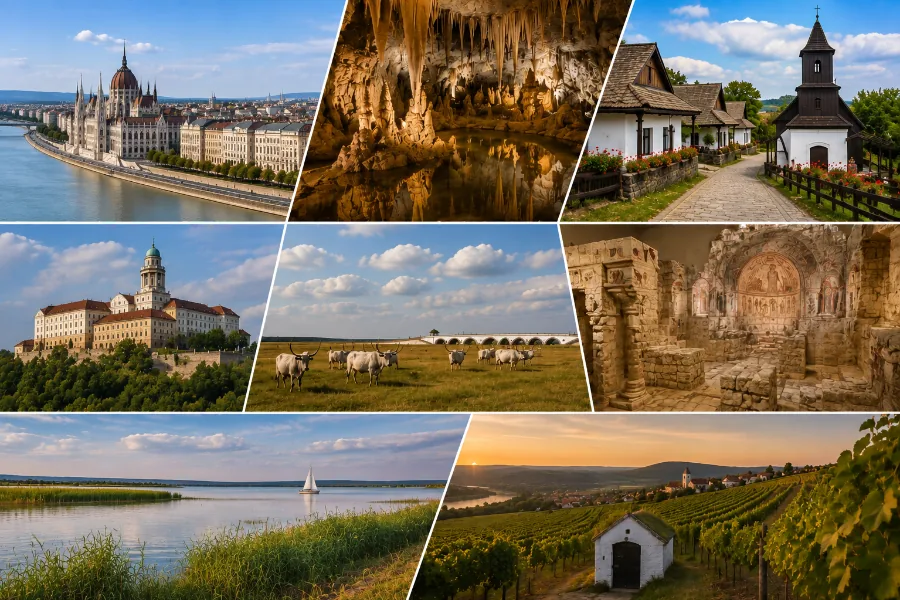
Budapest, the capital, straddles both banks of the Danube, with the Buda Castle Quarter and the Hungarian Parliament Building, completed in 1904, both UNESCO World Heritage sites. The Danube embankment and Andrássy Avenue, Budapest's grand boulevard leading to Heroes' Square, are also on the UNESCO list, along with the city's metro line, opened in 1896 and the oldest underground railway on the European continent. The village of Hollókő, known for its traditional Palóc folk architecture, is also a UNESCO World Heritage site, preserving a picture of Hungarian rural life from the 19th and 20th centuries. The early Christian burial chambers of Pécs, dating from the 4th century, remnants of the Roman-era city of Sopianae, are likewise on the UNESCO list.
Lake Balaton, the largest lake in Central Europe, is a major summer destination for both domestic and international tourism, its shores lined with wine regions such as Badacsony, along with beaches and sailing opportunities. Hungary's thermal water resources are exceptionally rich, with several hundred thermal springs and baths operating across the country, including Budapest's Széchenyi and Gellért baths, as well as Hévíz, home to one of the largest natural thermal lakes in the world. Hortobágy National Park, in the eastern part of the country, preserves the distinctive landscape of the Hungarian puszta and traditional livestock farming, including the Hungarian grey cattle breed, and is also a UNESCO World Heritage site. Local cuisine is built around paprika, with gulyás, a beef-based soup, and paprikás csirke, paprika chicken, as signature dishes, often served with nokedli (dumplings), while Hungarian wine regions, such as Tokaj, are known for one of the region's most famous sweet wines, Tokaji Aszú.
The Hungarian forint
The forint was introduced in Hungary on August 1, 1946, replacing the pengő, which had become practically worthless amid the hyperinflation following World War II, one of the most severe cases of hyperinflation in history, with prices at one point doubling on a daily basis. The name "forint" traces back to the medieval Florentine gold coin, the fiorino d'oro, which was already in use and imitated in Hungary as early as the 14th century under King Charles I, when the country minted its own gold coin also known as the "forint." At its introduction, the forint was backed by gold and began as an exceptionally stable currency, though this stability gradually weakened over the following decades, and after the fall of communism the country shifted to a market-based, floating exchange rate system. As a member of the European Union, Hungary is in principle obligated to eventually adopt the euro, though the exact timing remains an open question, meaning the forint continues to serve as the country's official currency for now.