Why Does China Have Only One Time Zone?
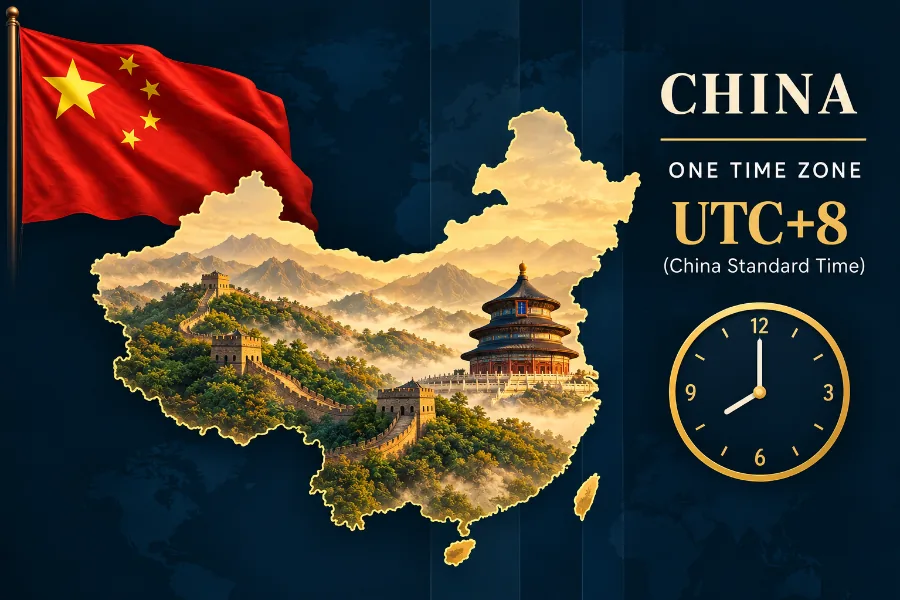
Look at a map of China's time zones and you won't find a single dividing line – just one solid color stretching across the entire country, even though the distance between its easternmost and westernmost points spans nearly five hours geographically. Behind this lies a political decision from 1949, one whose effects still shape when people in the country's east and west wake up and go to bed today.
Five time zones become one – the 1949 decision
Before 1949, China officially used five time zones, ranging from UTC+5:30 to UTC+8:30, which made geographic sense for a country of this size. After Mao Zedong and the Chinese Communist Party came to power, they decided to introduce a unified time system: a single official time for the entire country, named after the capital – Beijing Time (UTC+8), also known today as China Standard Time.
The decision wasn't just practical, it also carried strong political intent: a single clock became a symbol of national unity, and it simplified nationwide news broadcasting, government coordination, and communication between provinces.
What does this mean in daily life?
At UTC+8, Beijing sits fairly close to its actual solar time, with winter sunrise around 7:24 AM and summer sunrise as early as around 4:45 AM. In China's far western border regions, however, like Kashgar or Ürümqi, winter sunrise can be as late as 10 AM Beijing Time, while in summer the sun doesn't set until around 11 PM – meaning official dinnertime can fall while it's still broad daylight outside.
How do people adapt?
In the country's west, mainly in the Xinjiang region, an unofficial "local time" has developed alongside official Beijing Time, running two hours behind. It's mostly used by the Uyghur population in daily life, while Han Chinese residents in the same region tend to stick to official time – which means asking two different people the time in the same city can get you two different answers.
In practice, this means offices, schools and shops in the western provinces typically open later by Beijing Time, to adapt to the actual daylight hours. Train and bus schedules, on the other hand, officially always follow Beijing time, so it's worth travelers being aware of this gap, especially in Xinjiang.
- Before 1949, China used 5 official time zones (UTC+5:30 – UTC+8:30)
- Today there's a single official time: Beijing Time / China Standard Time (UTC+8)
- In Kashgar, the sun rises around 10 AM in winter, by Beijing Time
- In Xinjiang, an unofficial "local time," two hours behind Beijing, is widely used
China's single time zone is a striking example of how a political decision can shape something as fundamental as when people wake up, work or have dinner, for decades to come. Anyone traveling to Xinjiang should be ready for the fact that daylight hours and clock time there diverge far more than they're used to.
Taiwan, Hong Kong and Macau – also UTC+8
Taiwan, which is politically separate from mainland China, along with the special administrative regions of Hong Kong and Macau, also use UTC+8 – meaning they effectively show the same time as mainland China. This isn't surprising, since all three areas sit roughly within the same longitude band as Beijing and Shanghai, so UTC+8 is actually close to their true solar time, unlike the case in Xinjiang. As a result, anyone planning a China–Taiwan–Hong Kong trip doesn't need to worry about time zone changes or resetting their watch when crossing borders.