Macau lies on China's southeastern coast, at the mouth of the Pearl River, west of Hong Kong, as one of China's Special Administrative Regions. Portugal acquired the territory as a trading post in 1557, making Macau both the first and the last European colony in China, until it returned to Chinese sovereignty in 1999. Under the "one country, two systems" principle, Macau maintains its own legal system, currency (the Macanese pataca), and border controls. The official languages are Cantonese and Portuguese, though the use of Portuguese in everyday communication has declined considerably. Macau has become one of the world's largest gambling centers, its revenues long surpassing those of Las Vegas.
The Ruins of St. Paul's, the facade being the only surviving part of a former Jesuit church destroyed by fire in 1835, is Macau's best-known symbol and part of the Historic Centre of Macau UNESCO World Heritage site, listed in 2005. Senado Square, with its Portuguese-style wave-patterned pavement and pastel-colored colonial buildings, forms the heart of the historic town center. The Macau Tower, a 338-meter observation tower that also functions as a bungee-jumping site, is a symbol of modern Macau. The Venetian Macao and similarly massive casino complexes on the Cotai Strip form the center of modern Macau's gambling industry, built in the mold of Las Vegas.
Coloane, the less developed southern part of Macau, with its sandy beaches and greener landscape, offers a quieter alternative to the bustling casino districts of the Macau Peninsula and Taipa. The Guia Fortress and its adjoining lighthouse, the oldest operating lighthouse on the South China coast, offer panoramic views over the city and the neighboring Chinese mainland. Local cuisine, known as Macanese cuisine, is a unique blend of Portuguese and Cantonese influences, often considered one of the earliest fusion cuisines in the world, with Portuguese-style chicken (galinha à portuguesa) as a signature dish, while the local egg tart has become known as a variation of the Portuguese pastel de nata.
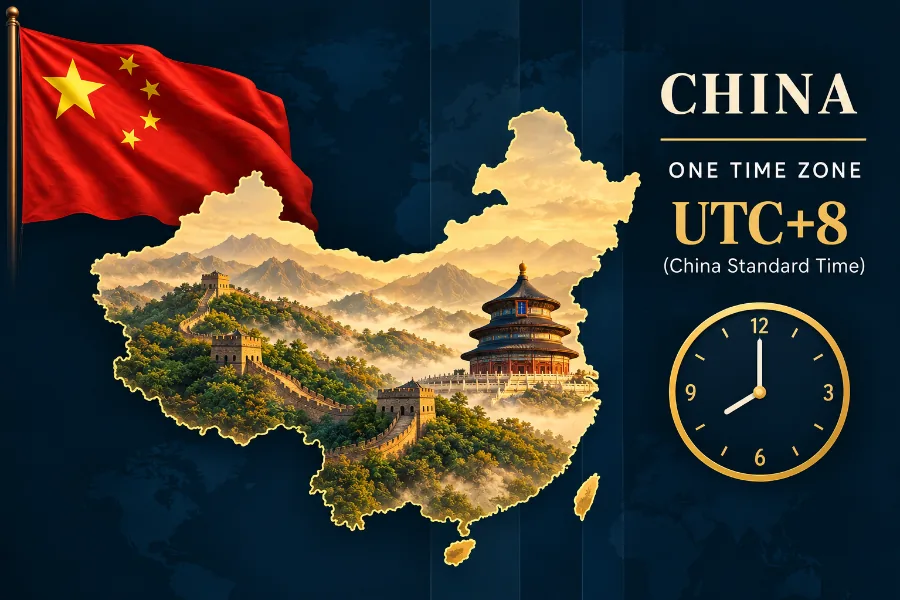
Look at a map of China's time zones and you won't find a single dividing line – just one solid color stretching across the entire country, even though the distance between its easternmost and westernmost points spans nearly five hours geographically. Behind this lies a political decision from 1949, one whose effects still shape when people in the country's east and west wake up and go to bed today.
Frequently asked questions
What is the capital of Macao?
The capital of Macao is Macao.
What is the area of Macao?
The area of Macao is 30 km².
What is the population of Macao?
The population of Macao is 687,000.
What is the currency of Macao?
The currency of Macao is Macanese pataca (MOP).
What is the official language of Macao?
The official language of Macao: Chinese, Portuguese.