Hong Kong lies on China's southeastern coast, at the mouth of the Pearl River, as one of China's Special Administrative Regions. Britain acquired the territory in 1841 following the First Opium War, and in 1898 leased the larger mainland area known as the New Territories for 99 years; the expiration of this lease led to the handover of the entire territory to China in 1997. Under the "one country, two systems" principle, Hong Kong maintains its own legal system, currency (the Hong Kong dollar), and border controls, meaning most travelers require a separate border crossing to enter mainland China. The official languages are Cantonese and English, and the territory also plays a significant role as an international financial hub.
Victoria Peak, the highest point on Hong Kong Island, offers panoramic views over the skyline and Victoria Harbour, and is reached by the Peak Tram, a funicular railway operating since 1888. The two shores of Victoria Harbour, Hong Kong Island and the Kowloon Peninsula, are connected by the Star Ferry, which has operated for more than a century and remains a traditional way to see the city. Man Mo Temple, a Taoist-Confucian shrine built in the 19th century, is one of the city's surviving monuments to Chinese religious tradition predating colonial rule. The Big Buddha statue on Lantau Island, erected in 1993, is one of the world's largest outdoor seated bronze Buddha statues.
About 40 percent of Hong Kong's territory is protected natural land, despite the city center being one of the most densely built-up areas in the world, a contrast that allows visitors to reach green hillsides just a few hours' hike from the skyscrapers. The Dragon's Back trail, on the southern side of Hong Kong Island, offers panoramic views over the coastline and neighboring islands. Local cuisine is built on Cantonese foundations, with dim sum, small steamed or fried dishes served in portions, as a signature tradition, traditionally enjoyed with tea as a communal meal, while street food culture, including steamed dumplings and curry fish balls, remains an integral part of daily life.
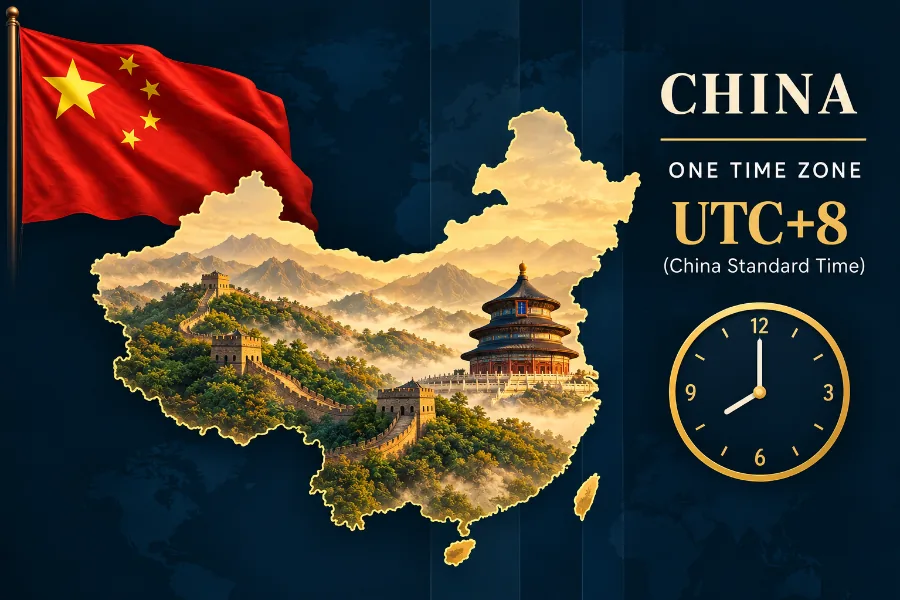
Look at a map of China's time zones and you won't find a single dividing line – just one solid color stretching across the entire country, even though the distance between its easternmost and westernmost points spans nearly five hours geographically. Behind this lies a political decision from 1949, one whose effects still shape when people in the country's east and west wake up and go to bed today.
Frequently asked questions
What is the capital of Hong Kong?
The capital of Hong Kong is Hong Kong.
What is the area of Hong Kong?
The area of Hong Kong is 1,104 km².
What is the population of Hong Kong?
The population of Hong Kong is 7,524,100.
What is the currency of Hong Kong?
The currency of Hong Kong is Hong Kong dollar (HKD).
What is the official language of Hong Kong?
The official language of Hong Kong: Chinese, English.