All 50 US States – Complete List with Capitals and Regions
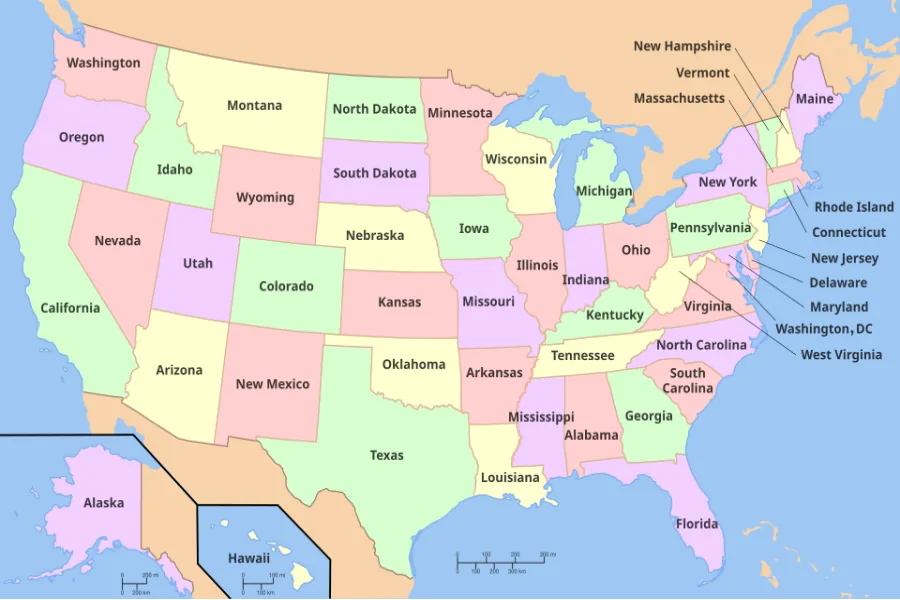
The United States is made up of 50 states, and they can differ quite a bit in size, character, and even time zone. In this article we've put together all 50 states in alphabetical order, along with their abbreviation, capital, and the region they belong to – so you can see at a glance what's where in the country.
How is the USA structured?
Besides its 50 states, the USA also has a federal district (Washington D.C.), which isn't a state but is home to the nation's capital. States are often grouped into four larger regions: Northeast, Midwest, South, and West. This grouping isn't an official administrative division – it's more of a widely used classification based on climate, history, and culture. In the list below, each state's region is noted.
List of states
- Alabama (AL) – capital: Montgomery – region: South
- Alaska (AK) – capital: Juneau – region: West
- Arizona (AZ) – capital: Phoenix – region: West
- Arkansas (AR) – capital: Little Rock – region: South
- California (CA) – capital: Sacramento – region: West
- Colorado (CO) – capital: Denver – region: West
- Connecticut (CT) – capital: Hartford – region: Northeast
- Delaware (DE) – capital: Dover – region: South
- Florida (FL) – capital: Tallahassee – region: South
- Georgia (GA) – capital: Atlanta – region: South
- Hawaii (HI) – capital: Honolulu – region: West
- Idaho (ID) – capital: Boise – region: West
- Illinois (IL) – capital: Springfield – region: Midwest
- Indiana (IN) – capital: Indianapolis – region: Midwest
- Iowa (IA) – capital: Des Moines – region: Midwest
- Kansas (KS) – capital: Topeka – region: Midwest
- Kentucky (KY) – capital: Frankfort – region: South
- Louisiana (LA) – capital: Baton Rouge – region: South
- Maine (ME) – capital: Augusta – region: Northeast
- Maryland (MD) – capital: Annapolis – region: South
- Massachusetts (MA) – capital: Boston – region: Northeast
- Michigan (MI) – capital: Lansing – region: Midwest
- Minnesota (MN) – capital: Saint Paul – region: Midwest
- Mississippi (MS) – capital: Jackson – region: South
- Missouri (MO) – capital: Jefferson City – region: Midwest
- Montana (MT) – capital: Helena – region: West
- Nebraska (NE) – capital: Lincoln – region: Midwest
- Nevada (NV) – capital: Carson City – region: West
- New Hampshire (NH) – capital: Concord – region: Northeast
- New Jersey (NJ) – capital: Trenton – region: Northeast
- New Mexico (NM) – capital: Santa Fe – region: West
- New York (NY) – capital: Albany – region: Northeast
- North Carolina (NC) – capital: Raleigh – region: South
- North Dakota (ND) – capital: Bismarck – region: Midwest
- Ohio (OH) – capital: Columbus – region: Midwest
- Oklahoma (OK) – capital: Oklahoma City – region: South
- Oregon (OR) – capital: Salem – region: West
- Pennsylvania (PA) – capital: Harrisburg – region: Northeast
- Rhode Island (RI) – capital: Providence – region: Northeast
- South Carolina (SC) – capital: Columbia – region: South
- South Dakota (SD) – capital: Pierre – region: Midwest
- Tennessee (TN) – capital: Nashville – region: South
- Texas (TX) – capital: Austin – region: South
- Utah (UT) – capital: Salt Lake City – region: West
- Vermont (VT) – capital: Montpelier – region: Northeast
- Virginia (VA) – capital: Richmond – region: South
- Washington (WA) – capital: Olympia – region: West
- West Virginia (WV) – capital: Charleston – region: South
- Wisconsin (WI) – capital: Madison – region: Midwest
- Wyoming (WY) – capital: Cheyenne – region: West
US overseas territories
Beyond the 50 states and Washington D.C., the United States also has several overseas territories that aren't states but still fall under US jurisdiction. Puerto Rico is the largest of these, with its own capital (San Juan) and significant autonomy in local affairs. Guam and the Northern Mariana Islands are located in the Pacific, in the Australia and Oceania region, as is American Samoa. The US Virgin Islands lie in the Caribbean, while the United States Minor Outlying Islands are a scattered group of mostly uninhabited islands, more relevant for military and scientific purposes than tourism. These territories each have different degrees of self-governance, but none of them are states – their residents are US citizens (or US nationals, in the case of American Samoa), though they can't vote in presidential elections.