Which Country Has the Most Time Zones?
If you asked which country has the most time zones, most people would guess Russia or the United States. The actual answer is France, and by a fair margin: it has 12, sometimes even 13, time zones, even though mainland France itself sits in just a single time zone.
How can a 1,000 km wide country have 12 time zones?
Mainland France is only about 1,000 km wide and sits entirely within Central European Time (CET, UTC+1) – on its own, that wouldn't suggest a world record for time zones. The explanation lies in its overseas departments and territories: France holds islands or regions in nearly every ocean on the planet, each following its own local time zone.
These territories are scattered from the Caribbean (Guadeloupe, Martinique) through the Pacific (French Polynesia, New Caledonia) to the Indian Ocean (Réunion, Mayotte), each following the time zone appropriate to its geographic location.
France's time zones
- French Polynesia – Tahiti UTC-10:00
- French Polynesia – Marquesas Islands: UTC-9:30
- French Polynesia – Gambier Islands: UTC-9:00
- Guadeloupe, Martinique, Saint Barthélemy, Saint Martin: UTC-4:00
- French Guiana: UTC-3:00
- Saint Pierre and Miquelon: UTC-3:00 (standard), UTC-2:00 (summer)
- Metropolitan France: UTC+1:00 (standard), UTC+2:00 (summer)
- Mayotte: UTC+3:00
- Réunion: UTC+4:00
- French Southern and Antarctic Lands: UTC+5:00
- New Caledonia: UTC+11:00
- Wallis and Futuna: UTC+12:00
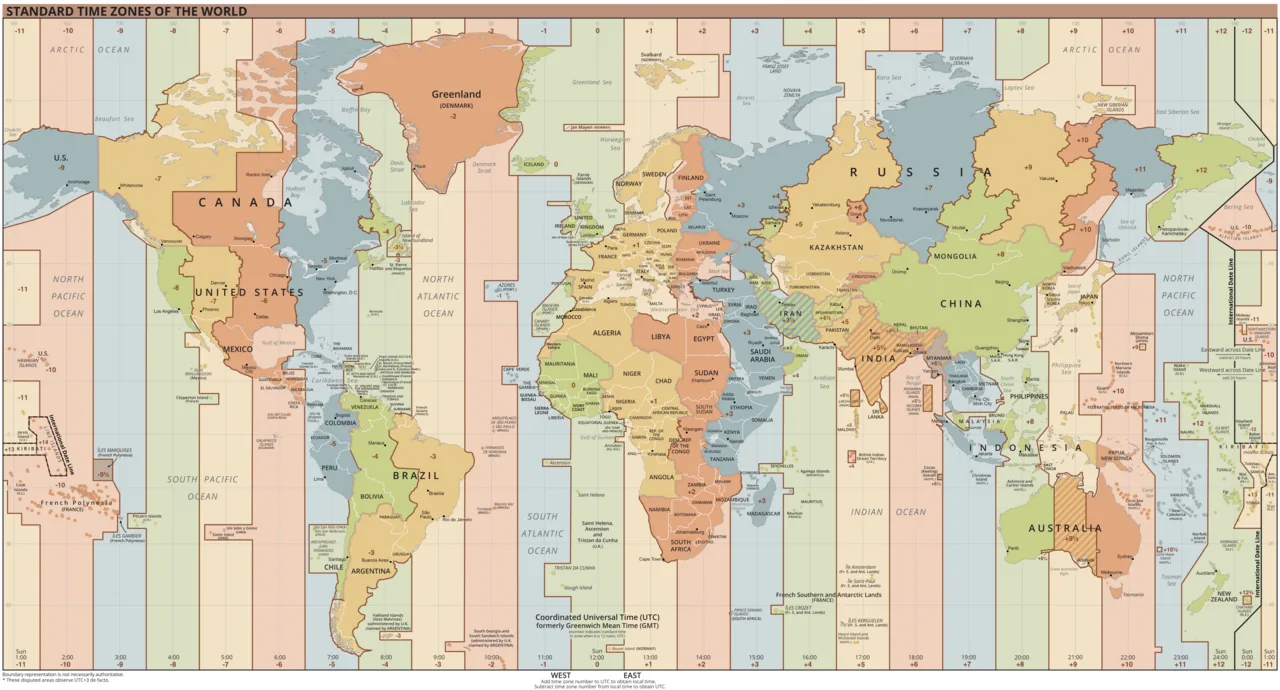
When does the 13th time zone appear?
Saint Pierre and Miquelon is the only French territory that observes daylight saving time, and it does so on the North American (Canadian) schedule rather than the French or European one, from March to November. During this period the territory shifts from UTC-3 to UTC-2, temporarily splitting off from the other UTC-3 French territories (such as French Guiana). For a few months each year, this means 13 different local times are actually in use across French territory at the same time.
Who takes the rest of the podium?
Behind France, the United States and Russia share second place, both with 11 time zones. Interestingly, Russia once had 11 time zones purely within its mainland territory, which were reduced to 9 in 2010 for the sake of economic efficiency. In the US case, only 6 of the 11 time zones come from the 50 states themselves; the rest are due to overseas territories such as Puerto Rico, Guam, American Samoa, and others.
France's time zone record, then, comes not from its geographic size but from the overseas territories left behind by its colonial history – a great example of how a country's footprint on the map doesn't always reflect its true global reach.